Biography
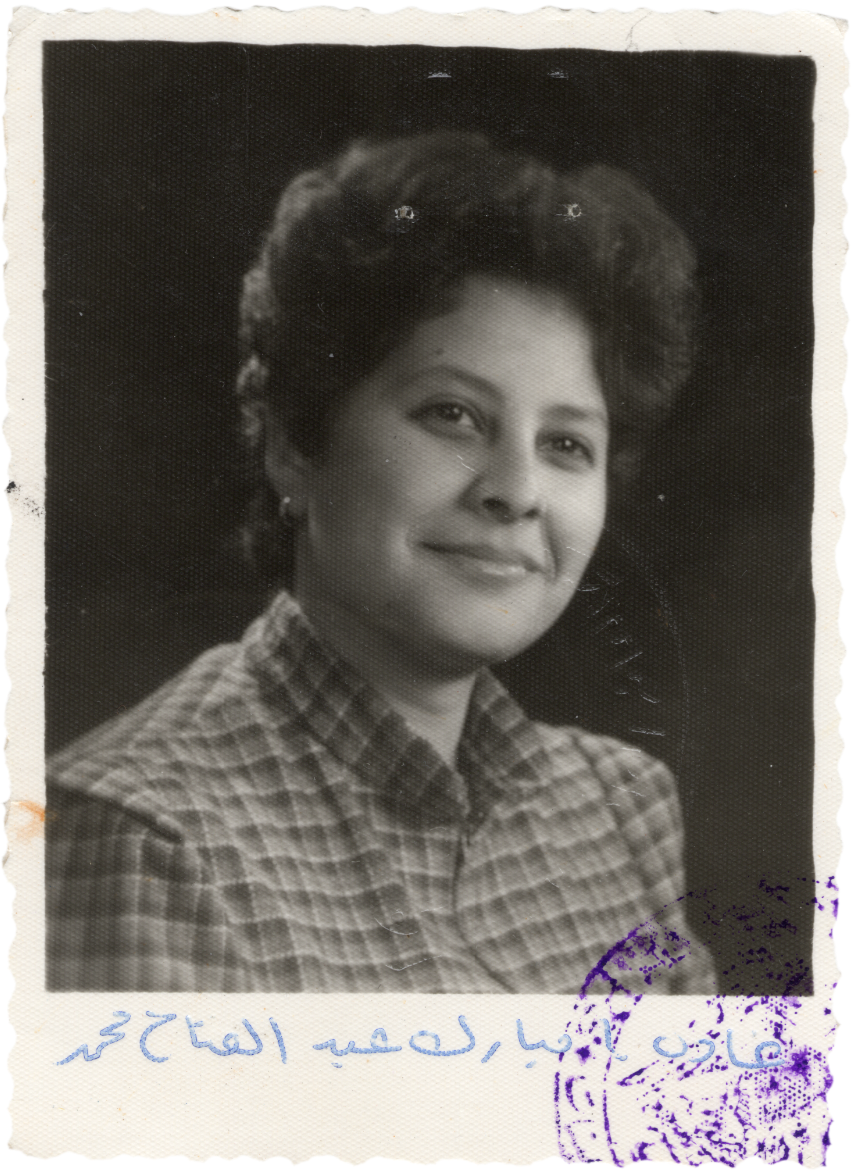
Ghada Embarek is an Egyptian artist whose work is rooted in an enduring fascination with the ways human beings communicate beyond words. Through painting, drawing, watercolor, ink, and mixed media, she explores the human figure as a carrier of emotion, memory, intuition, and psychological tension. Faces may disappear, bodies overlap, and recognizable forms dissolve into lines and gestures, yet the human presence remains.
For Ghada, art is fundamentally a language—one without fixed letters or forms, and one that does not need to be learned or translated. The artist may be one, she has written, but the readers are many; with each new viewer, the language changes, reshapes itself, and forms a different relationship.
Childhood and beginnings
Born in Giza in 1966 and raised largely in Upper Egypt, she spent three months of every childhood summer at her grandmother's house. An inner room there was crowded with large white statues, and the dining room walls held plaster plates carved with stairways, landscapes and people.
They were the work of her mother's family. Her great-grandfather was a sculptor, and so was her mother's uncle, Ahmed Wahby Shaker, the first Egyptian to teach sculpture at the School of Fine Arts in Zamalek, who died young, long before she was born. At four or five she would slip into that room just to look. Her mother painted too, beautifully, though she set it aside for her children. Her aunt Salwa, an entomologist, brought her art books from the Cairo Book Fair every year and told her stories from the Thousand and One Nights at bedtime.
At twelve, an art teacher named Saeed began pulling her out of class and into his studio. He taught her to float oil paint on water and lay paper across it. The image makes itself, and your only part is moving the colours. They hung the sheets up to dry like laundry. At thirteen her first exhibited painting, a large picture about peace, went up above the headmaster's desk. After that, she says, she knew she couldn't become anything else.
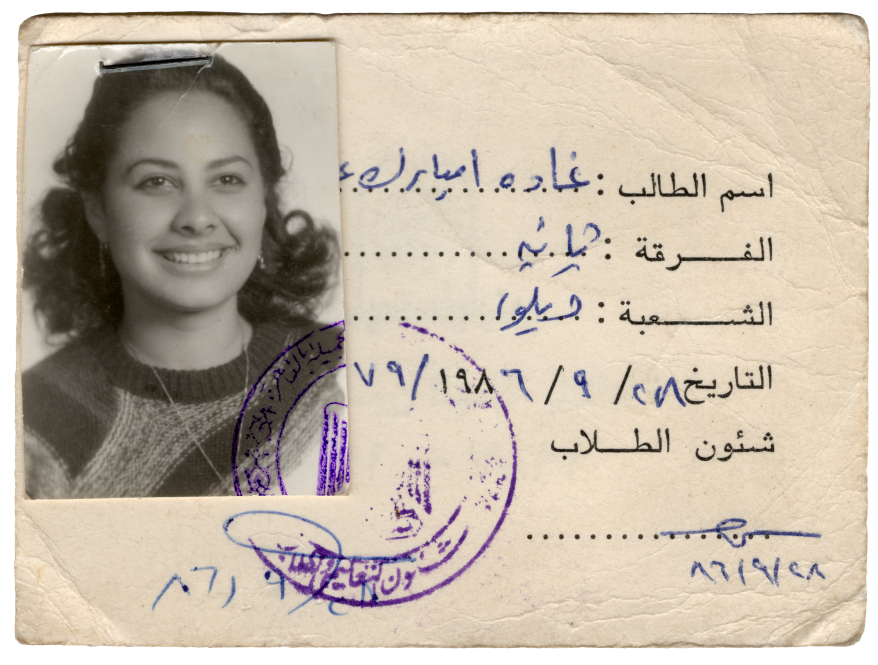
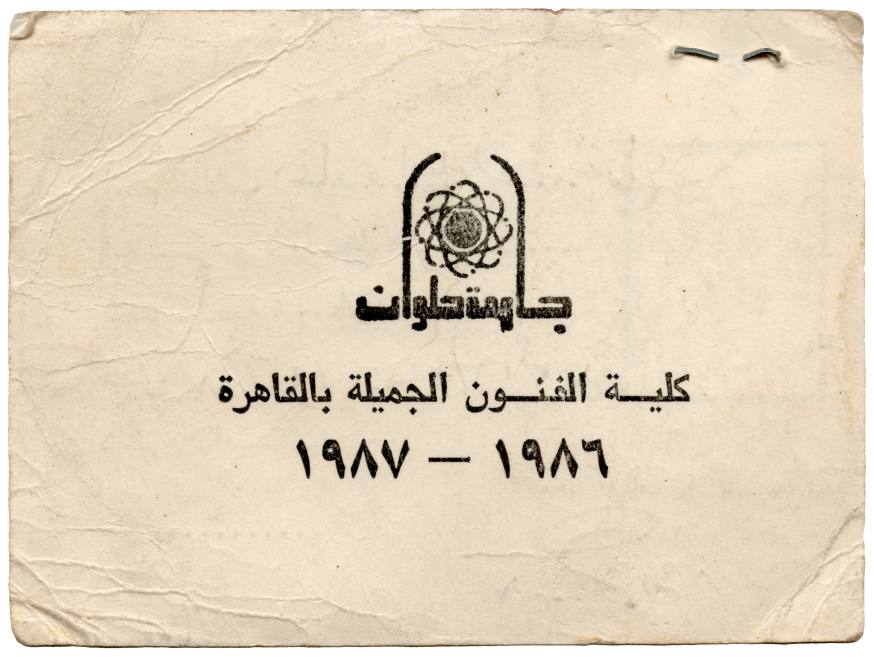
Her mother, seeing her gift for physics and mathematics, asked her to study science first. Ghada agreed, lasted two weeks, then quietly withdrew her papers without telling her and took them to the Faculty of Fine Arts in Zamalek, where she was accepted on the spot. On her first day the dean, the artist Salah Abdel Kerim, kept the gates shut until the building had been scrubbed clean, then threw them open. She still calls it the gate of paradise. She studied decoration, specialising in stage and cinema design, but practically lived in the sculpture and mural studios ("my heart is closer to sculpture"). She graduated in 1989 convinced that an artist is born, then made by passion and constant practice.
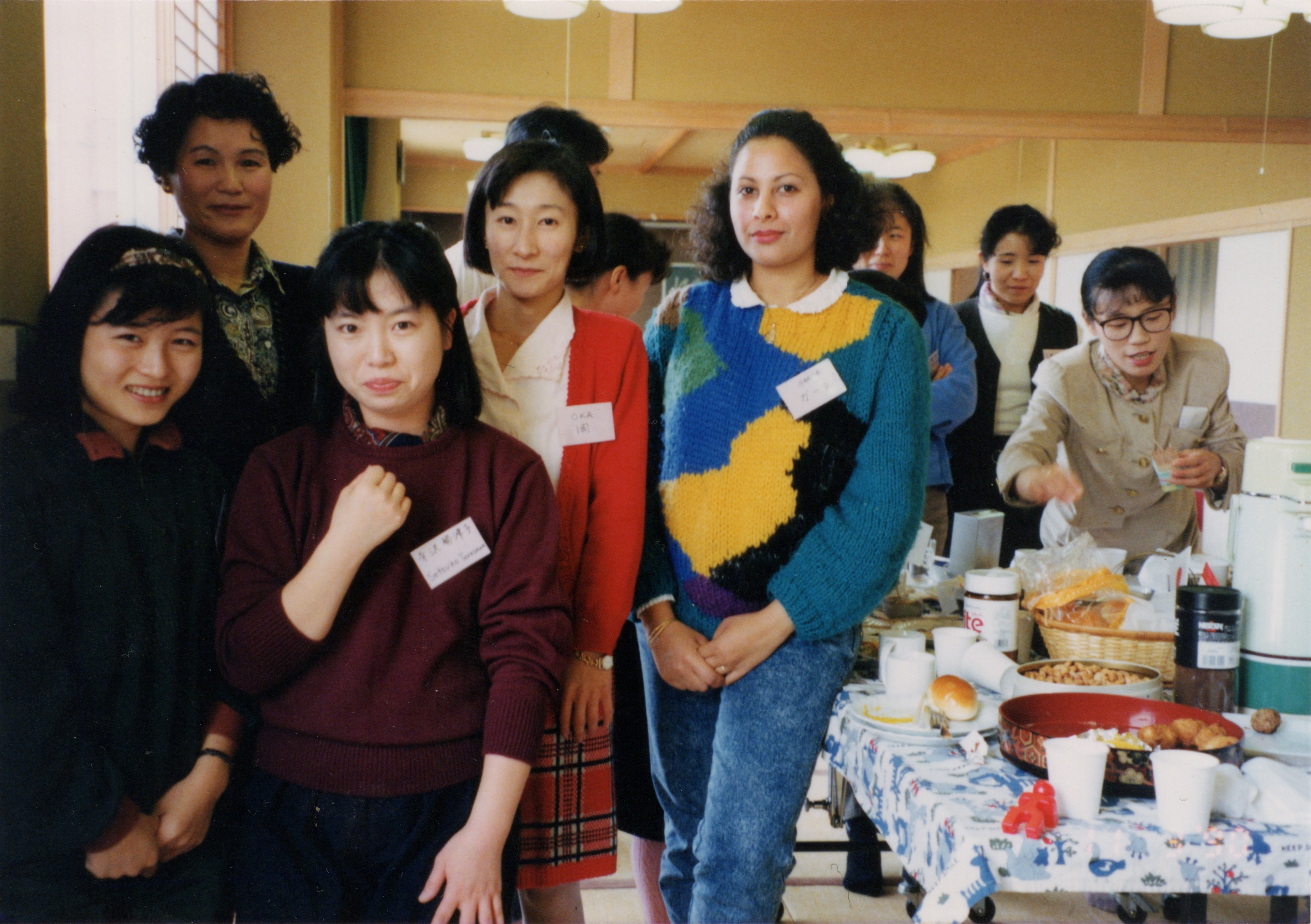
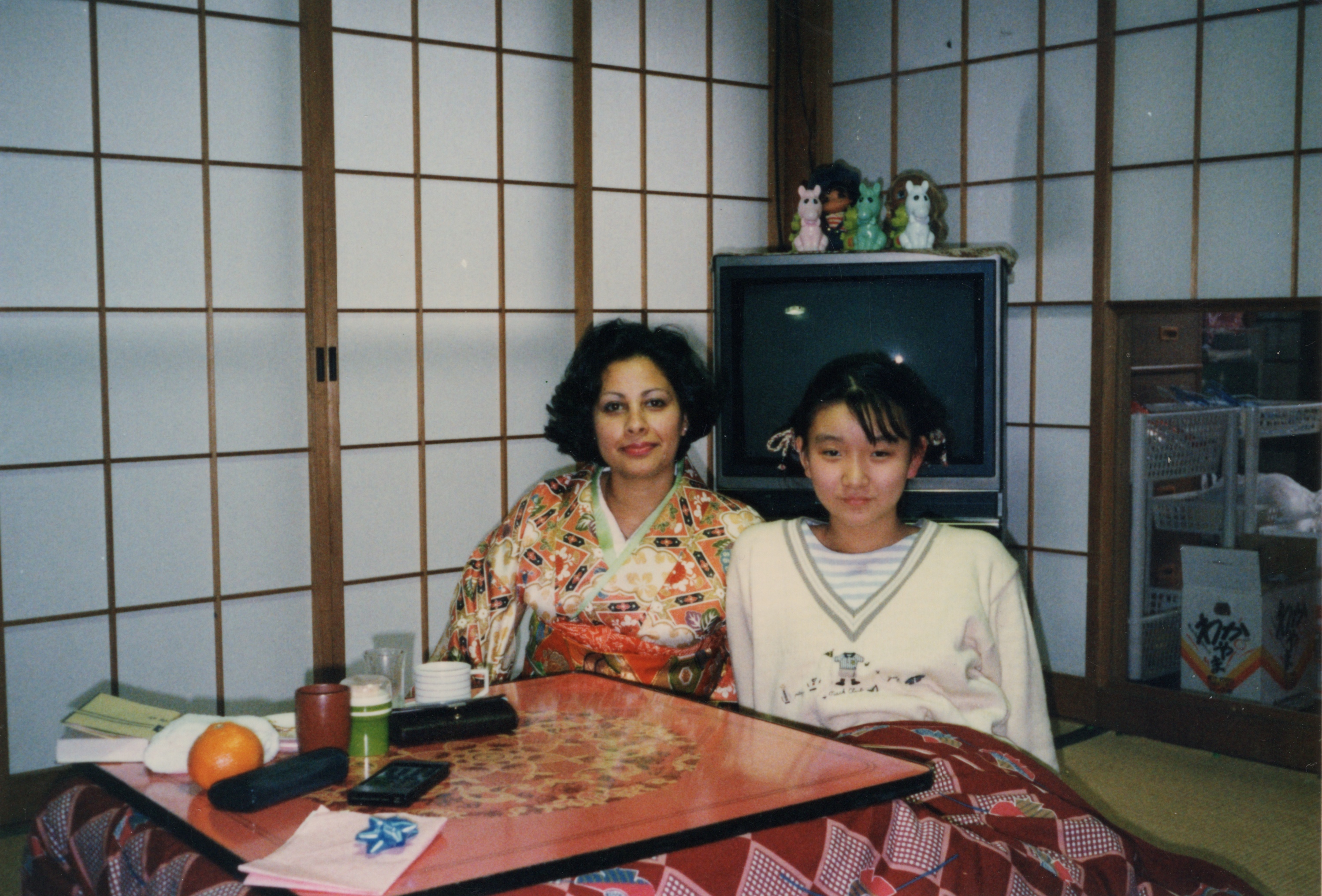
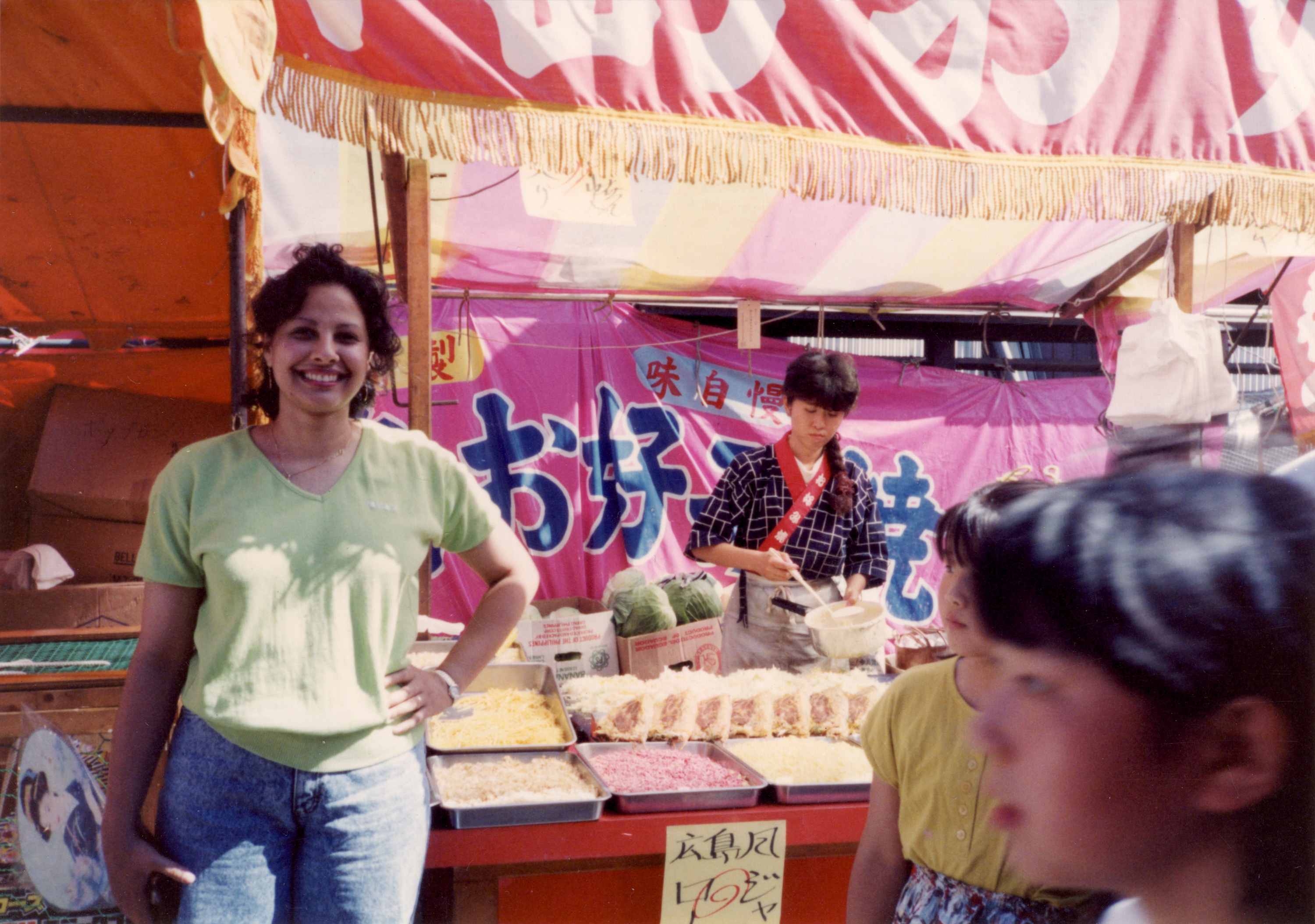
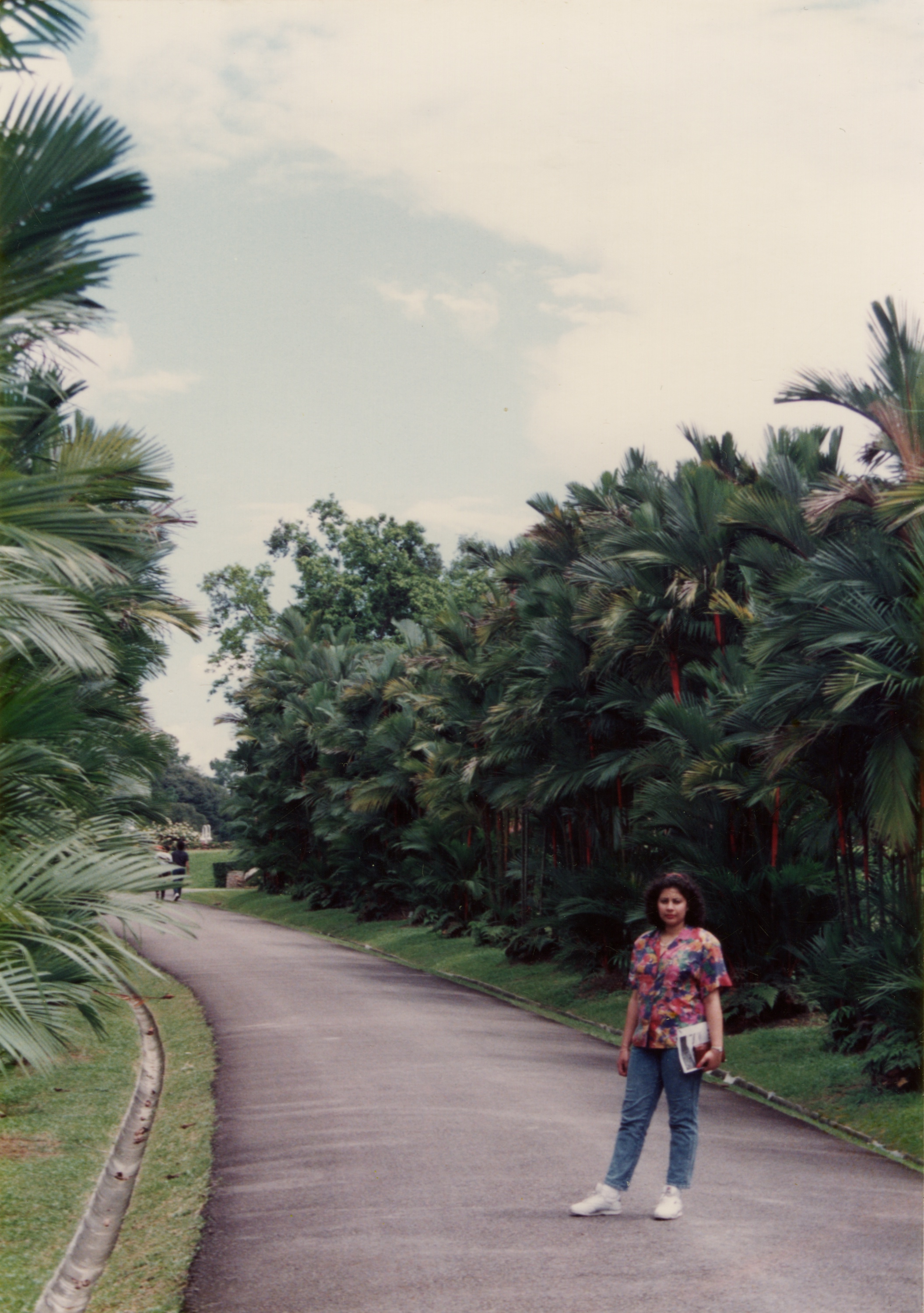
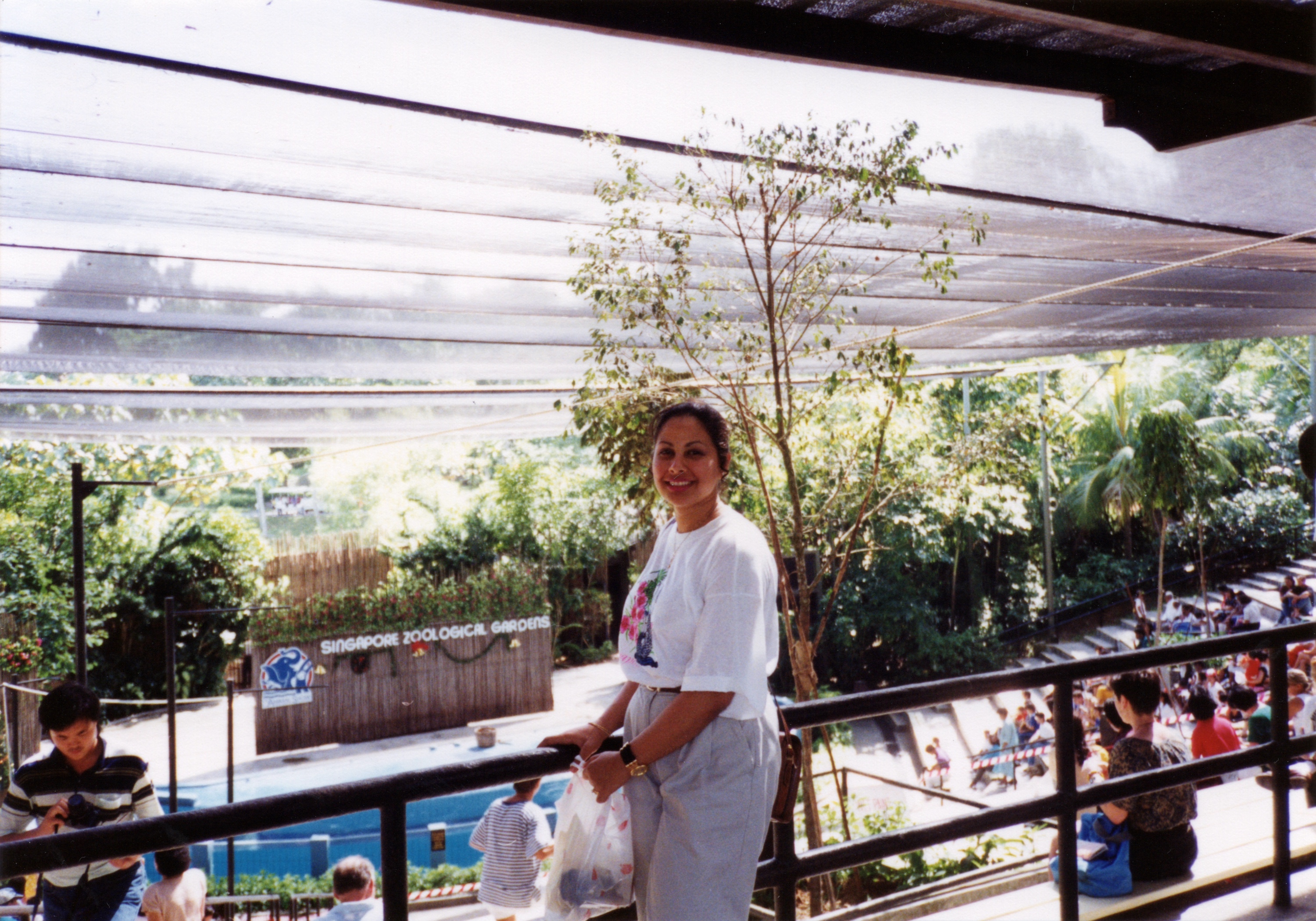
Within two months of graduating she was living in Niigata. It was the start of nearly three years in the Far East, in Japan, China, Singapore and Indonesia. In Japan she learned calligraphy with ink on rice paper and a squirrel-hair brush, made traditional dolls by hand, and went to kabuki and sumo. Each month she collected the new stamps from the post office next door and copied the faces on them, African faces above all. In Bali she photographed the paintings in every hotel room. She calls those years her bank, a store of visual memory she still draws on.
Back in Cairo she opened a gallery called Per Nefer, ancient Egyptian for "the beautiful house," the name the ancients gave to the house that readied the dead for eternity. She designed every detail of it herself. She painted on silk in a glass-walled studio while visitors watched, and held her first exhibitions there in 1992 and 1993. She also gave a show to her aunt Salwa, whom she had finally persuaded to paint the butterflies and insects she had spent a career classifying.
Artistic practice
The next twenty years were private but never still. Ghada painted and sold from home, showed in group exhibitions, and in 1999 opened a studio to teach children, women and young people. She doesn't believe art can be taught, so she teaches only technique, inside a painting the student makes entirely their own.
In 2010 the European Union invited her to bring her course, "Transform the place you live into a place you love," to Bedouin women in Saint Catherine, South Sinai. In their dialect she renamed it "We want to decorate the wall." The women designed their own motifs and she wrote a note on each sheet. Years later, when she returned, they brought out the papers with her handwriting still on them.
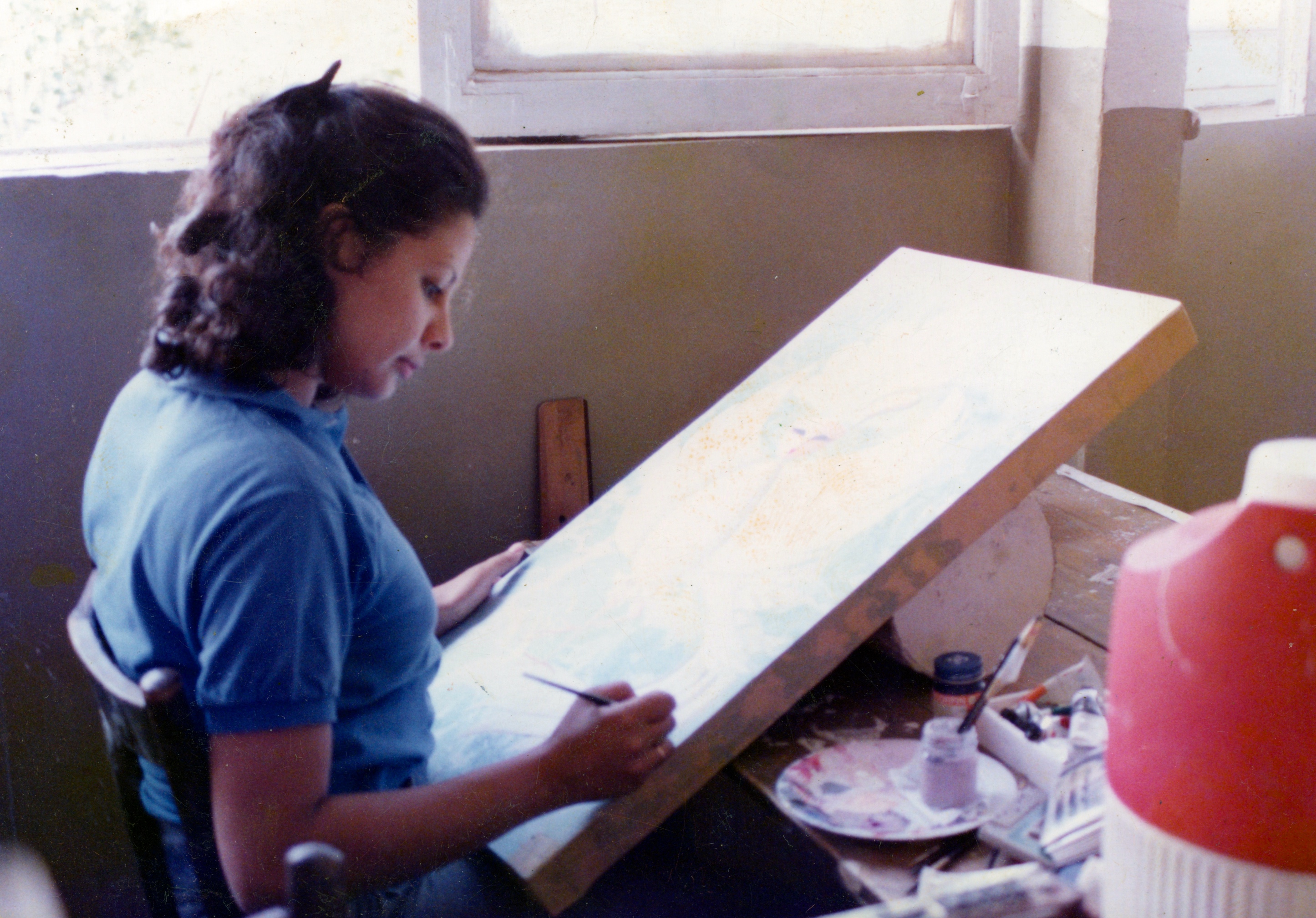
She paused for roughly three years with each of her children, and kept drawing anyway. Once she produced a whole body of work in her car while waiting outside her daughter's exams. "A day I don't work, I don't count as part of my life. It's lost." Since 2009 she has painted with El Lakta El Wahda (One Shot), a group of artists who go out to paint together every Friday.
In 2013, after her students asked her what a motif was, she answered with an exhibition, Endangered, at the American International School in Cairo. She also painted a large canvas live in front of the students without planning a single stroke.
Exhibitions and projects
In 2017 she showed in Rome and at the 11th Florence Biennale. With her children grown, she knew she couldn't stay away again. Then two exhibitions shook her. The first was a Samir Fouad retrospective, which felt "like someone grabbed me by the shoulders and said, wake up." The second was the work of the late Abdel Rahim Shahin, whom she met at the Cairo Opera House in early 2018. He pointed out a detail in one of her paintings hanging in a group show nearby. She came back the next day, the show's last, with her paints and fixed it on the wall, and he told her that was exactly what he loved in an artist.
"I needed to eat art," she says. She went to every opening and every symposium she could, "not just to paint, but to discover what's inside." During one symposium in Dahab she got into a car alone and drove to Saint Catherine, where she spent three days asking herself who she was and what she wanted. She came back and took a studio of her own, her "bubble," because, she admits, "the moment there are people around me, I'm not there."
If Fouad and Shahin were the spark, she says, what followed was fireworks. To the Peak (2019) began in a field on Gezirat El Dahab, where she came upon her old group painting a scarecrow. Its clothes were torn, the wind pushed it left and right, and birds landed on it and left. "I am the scarecrow," she realised. More than forty paintings followed, and with them she let all the sadness out.
Then she moved to Madinaty, the pandemic arrived, and she found herself "locked in paradise," with a window on green fields, a table, ink and paper. The Puzzle (2020) came out of that confinement as small black-and-white works hung in a long row like a strip of film. With it, unbidden, came Upper Egypt. That work led her to Luxor Art Gallery, and the same year one of her pieces entered the permanent collection of the Museum of Modern Egyptian Art. Rendez-Vous (2021, El Bab Selim Gallery) was made in the same dreamlike calm: wide white spaces and stillness. A few visitors told her the paintings belonged in a psychiatric hospital, to calm wounded souls.
The question underlying Embarek's later work became increasingly explicit with Wesh Meraya (2022). Its starting point was deceptively simple: Who are you?
The title derives from the Egyptian expression “min el-wesh maraya, min el-afa selaya”—roughly, a mirror to your face and a joke behind your back—describing the distance that can exist between someone's outward warmth and their concealed intentions.
The earliest works began almost as question marks constructed from a continuous line. But the question refused to remain simple. Since then the faces have multiplied. One sits above, beside, behind or inside another, with fish and birds slipping between them, until the work has become less portrait than confrontation, several presences speaking to each other at once. The compositions became denser as the question itself became more complex.
Ka (2025) turned to the ancient Egyptian idea of the soul's double. Light of the Shadow (2026), drawn in ink on cotton paper partly in Cairo and partly in Australia, returned to Upper Egypt in black and white. "I chose black and white so I could hear the light speak and watch the shadow tell its stories," she writes. "In black and white nothing hides behind colour. Shadow, for me, isn't darkness. It's depth, the place where light truly shows." She sees the series as the first chapter of a larger work, in which the drawings become a setting for her own poetry about the South, performed in Sa'idi dress.
Traces
Across Ghada's practice, the recurring figure is therefore less a subject than a meeting place: between one person and another, between outward appearance and interior life, between memory and the present, between light and shadow, between instinct and understanding, and between the artist and parts of herself she has not yet discovered.
Perhaps this is why Ghada's work continually returns to things that can be felt more easily than they can be named. A body without a face. A memory without a narrative. A shadow that reveals rather than conceals. A line that becomes two people, then many. Her ambition is to find what she calls a strong, new and truthful artistic sentence.
Ghada Embarek is a working member of the Syndicate of Fine Arts, the Association of Fine Arts Lovers and El Lakta El Wahda. She has exhibited at the 11th Florence Biennale, in Rome, at the Museum of Islamic Art in Cairo, in successive editions of Egypt's General Exhibition of Fine Arts, and at Art D'Égypte. Her work is in the permanent collection of the Museum of Modern Egyptian Art, which also holds work by the great-uncle whose statues she visited as a child, and in private collections in Egypt, Japan, Italy, the United States and Australia. She lives and works in Giza.